whats_running
Full snapshot in one call — use at session start.
For developers running coding agents
Model memory is a cache with no invalidation. Your agent will confidently tell you a server is running because a doc said so months ago. The OS is the only thing that actually knows. We build the tooling that keeps an agent fleet honest — starting with a free MCP server that hands the OS straight to the model.
Free · MIT · no telemetry
An MCP server that tells your agent what is actually running on the machine — live agent sessions, listening TCP ports, loaded daemons, system load — read straight from the OS via ps, lsof, launchctl and df. Never from docs, transcripts, or memory files.
claude mcp add --scope user whats-running -- npx -y whats-running-mcpFull snapshot in one call — use at session start.
Which agent processes are live? Terminal-attached vs detached orphan, with pid, uptime, working directory.
Is service X actually up? Every TCP LISTEN socket with its owning process.
What persistent services are loaded? launchctl on macOS, systemd --user on Linux.
Load average, uptime, root-disk free space.
Every command is a fixed binary with fixed flags via execFile — no shell, and nothing derived from model input is ever executed.
Also free
whats-loaded-mcp
What is consuming your context window before a session starts — skill descriptions ranked by token cost, skills installed more than once, and CLAUDE.md/AGENTS.md sizes including what their imports pull in.
npx -y whats-loaded-mcp
whats-inherited-mcp
What a checkout tells your agent to do before you run it — instruction files, commands wired to auto-run, declared MCP servers, and shipped skills. Repo strings come back labelled as data, not instructions.
npx -y whats-inherited-mcp
whats-allowed-mcp
What your agent can already do without asking. Permission rules live across as many as five settings files at once, and some rule shapes are accepted and then quietly ignored. This merges all of them with provenance — which file each rule came from, which defaultMode wins, and what runs unattended.
npx -y whats-allowed-mcp
The problems these answer
Written answers, not brochures — each one is complete on its own whether or not you install anything.
whats-running-mcp
Configured, connected and running are three different states with three different checks — and the process count is always higher than the server count.
Read →whats-loaded-mcp
Scope resolution, shadowed definitions, pending approval and workspace trust, disable lists, launch failures, auth, tool search — in the order where each answer determines the next.
Read →whats-allowed-mcp
Why Claude Code still asks after you allowed it, and why your deny rule may protect nothing: evaluation order, five merged settings files, and the rule shapes that are never consulted.
Read →whats-running-mcp
How to tell an orphan from a live session, why the usual pkill one-liner takes out your current session and unrelated processes, and the safe sequence.
Read →The free server stays free. MIT, no telemetry, nothing held back to sell you later, and no dependency on anything below. If the paid kits disappeared tomorrow the server would be exactly as complete as it is today. Sponsorship is how the maintenance gets paid for instead.
Paid · $29 each · one-time
Both kits came out of running a one-person company on a fleet of coding agents, and every rule in them traces to a specific failure that cost us something. Instant download, single-operator commercial license, no subscription.
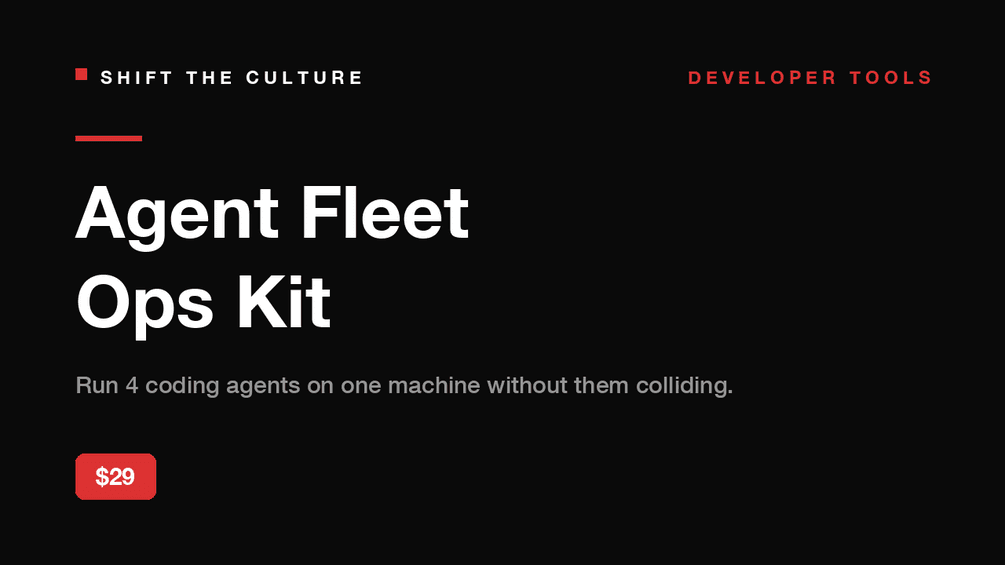
Run four coding agents on one machine without them colliding. If you run one agent, you don't need this. If you run three or four in parallel — Claude Code, Codex, Aider — you already know the failure modes: two sessions editing the same checkout, a dev server nobody owns, MCP servers leaked from crashed sessions holding ports for weeks.
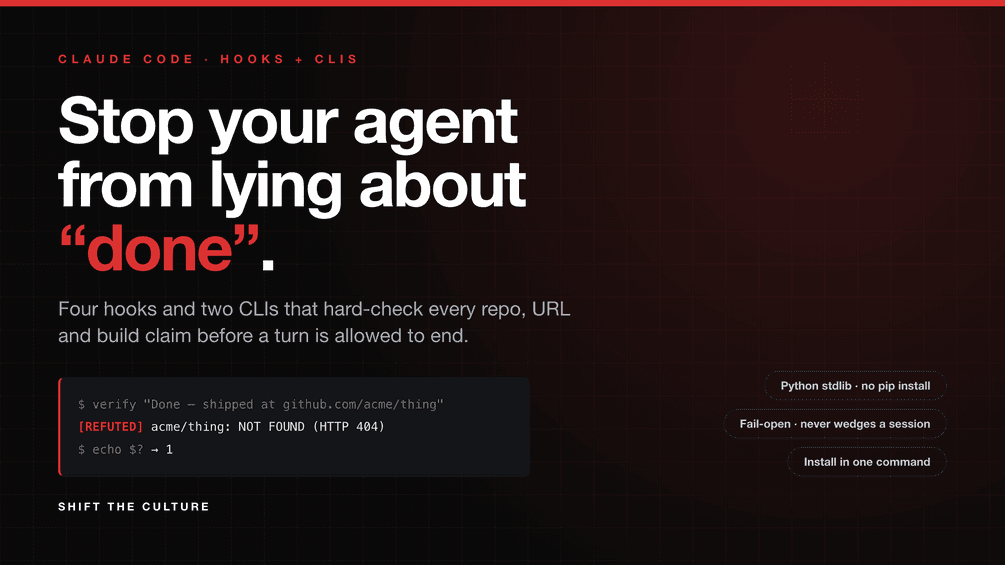
Four hooks and two CLIs that stop your coding agent from telling you it's done when it isn't. Asking the agent to double-check doesn't fix it — that's the same model confirming its own hallucination. The fix has to be structural: something outside the model that touches the outside world before the turn is allowed to end.
Not what you came for? The rest of the catalog — the operator course, the playbook bundle, the prompt arsenal — is on the Products page. Questions about either kit go to info@shifttheculture.media.